
AAV vector
AAVDJ-CAG-EGFP-CON
Serotype-defined, non-integrating delivery for long-term expression in non-dividing cells. Catalog number FAAVDJ-380,
part of the Adeno-Associated Virus (AAV) range. Send the catalog number with your
quantity and we will confirm availability, lead time and price.
Vector map
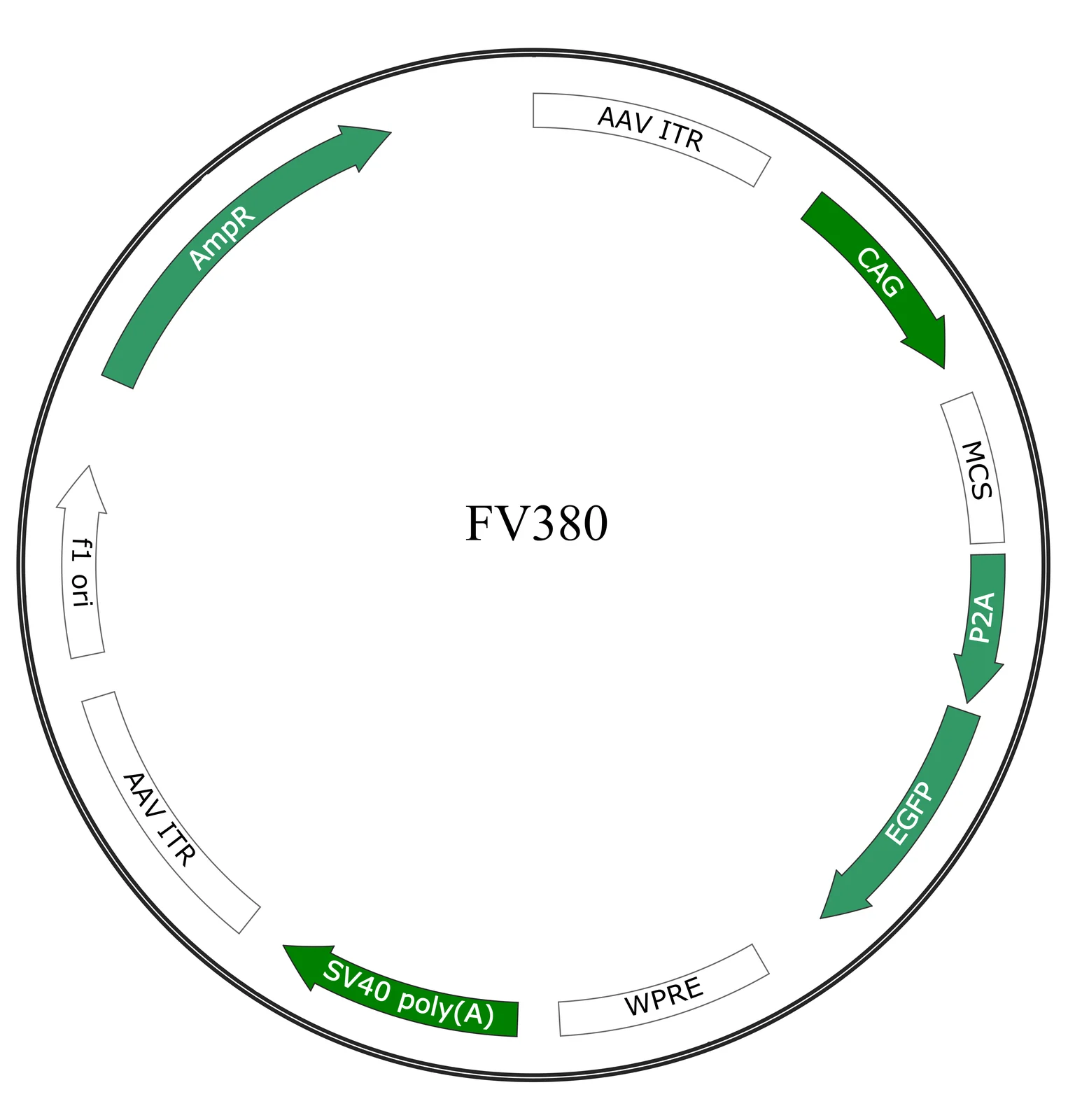
Click the map to enlarge it. Selected elements are annotated on the vector: promoter, expression cassette, selection marker and reporter.
How it works
Adeno-associated virus is a small, non-enveloped virus with a 4.7 kilobase single-stranded DNA genome flanked by inverted terminal repeats (ITRs). Recombinant AAV replaces the viral rep and cap genes entirely with the expression cassette between the two ITRs; rep/cap and adenoviral helper functions are supplied in trans during production, so the vector is replication-deficient by design.
The ITRs are the only cis-acting elements the vector needs, which means the cassette inside them can be rebuilt around any promoter and transgene within the packaging budget. After receptor-mediated entry and nuclear import, the single-stranded genome is uncoated, converted to double-stranded DNA and persists as head-to-tail episomal concatemers. There is no chromosomal integration in normal practice, so expression is long-lived in non-dividing tissue — this is the property behind the entire AAV gene-therapy field.
Serotype determines tropism: AAV2 is the classic HSPG-binding serotype, AAV6 and AAV9 each have distinct tissue profiles, and engineered capsids extend the range further. Onset of expression is slower than adenovirus or lentivirus — typically several days to two weeks — because second-strand synthesis is rate-limiting; self-complementary (scAAV) designs fold directly into dsDNA and express earlier, at the cost of halving the cargo budget to roughly 2.4 kilobases.

Production & quality control
- Vectors are produced by triple transfection of HEK293 cells: transfer plasmid, Rep/Cap plasmid of the chosen serotype, and an Ad2-derived helper plasmid.
- Lysate is clarified and purified by affinity chromatography followed by iodixanol gradient ultracentrifugation, then buffer-exchanged into the final formulation.
- Genome titer is reported in GC/mL (genome copies) by qPCR or dPCR against the ITR or transgene; sterility, endotoxin and mycoplasma are tested on every lot.
- Empty versus full capsid ratio and aggregate content can be characterized for lots intended for in vivo work — ask when requesting a quote.
Storage & handling
- Ship on dry ice; store at -80 degrees Celsius.
- Avoid more than one or two freeze-thaw cycles; aliquot after the first thaw.
- Dilute into the buffer recommended on the product sheet — AAV is sensitive to high salt and to repeated aggregation events at low concentration.
Experimental protocol
-
Choose the dose
For in vitro transduction, typical starting ranges are 10 to the 4 to 10 to the 5 genome copies per cell, and lower for highly permissive serotype-cell combinations. Run a dilution series the first time: AAV expression plateaus sharply and overshooting wastes stock without improving output.
-
Thaw and handle
Thaw on ice, mix gently and aliquot. AAV capsids are more freeze-thaw tolerant than enveloped viruses, but repeated cycling still degrades titer — single-use aliquots remain best practice.
-
Transduce
Add diluted AAV directly to the culture medium on cells at 50 to 80 percent confluence. No polybrene is required for most serotypes. Incubate 48 to 72 hours, then change medium; for slow-onset serotypes extend the incubation and read out later.
-
Read out
Expect first detectable expression at 3 to 7 days for standard single-stranded vectors and 1 to 3 days for self-complementary ones, with steady state reached over two weeks. Confirm by reporter, qPCR for vector genomes, or protein assay as appropriate.
-
Bank early
Because AAV expression is episomal and non-integrating, expression in a dividing culture declines with passaging. For stable lines, integrate the cassette via lentivirus instead, or keep the culture under a maintenance strategy decided up front.
Bench guidance only: AAV dosing is strongly serotype- and tissue-dependent. The ranges below are starting points for in vitro work — titrate for your own cells, and follow your institution's biosafety requirements.
Need the complete PDF manual with lot-specific parameters? Request the manual for FAAVDJ-380.
Frequently asked questions
Which serotype should I use?
For in vitro work AAV2 and AAV6 are good first choices for easy lines, AAV9 for broad screening. For animal work the tissue map matters: muscle tolerates many serotypes, CNS and retina have established preferences. Tell us the target tissue and we will suggest a starting serotype and dose.
Why is expression so slow?
The packaged genome is single-stranded and must be converted to dsDNA before transcription. Self-complementary AAV skips that step and expresses earlier, at the cost of halving the ~4.7 kilobase cargo budget.
How big a cargo can AAV carry?
About 4.7 kilobases between the ITRs for single-stranded genomes, roughly 2.4 for self-complementary. Oversized genomes package inefficiently and give erratic titer and expression.
Does AAV integrate into the genome?
Essentially no — episomal concatemers are the normal outcome. Rare integration events occur at a background frequency and are not relied on for expression.