
Adenoviral vector
AD-tdTomato-CON
E1/E3-deleted Ad5 vectors: very high titer, very strong transient expression, no chromosomal integration. Catalog number FAV283,
part of the Adenovirus range. Send the catalog number with your
quantity and we will confirm availability, lead time and price.
Vector map
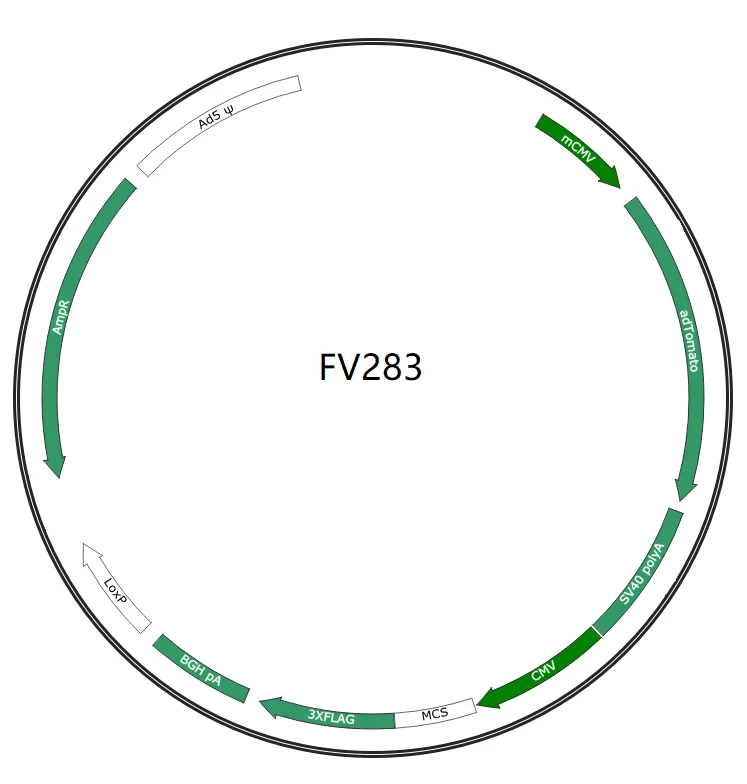
Click the map to enlarge it. Selected elements are annotated on the vector: promoter, expression cassette, selection marker and reporter.
How it works
Adenovirus is a non-enveloped, double-stranded DNA virus with a ~36 kilobase genome. In first-generation Ad5 vectors the E1 region — required for viral replication — is deleted and replaced by the expression cassette, and E3 is deleted to create packaging room. The vector therefore cannot replicate except in complementing producer cells such as HEK293, which supply E1 in trans.
After binding CAR via the fiber knob and integrins via the penton base, the particle is endocytosed, escapes the endosome and docks its genome at the nuclear pore. The DNA stays episomal: it is transcribed at very high levels for several days but is diluted out as the cell divides and is never inserted into chromatin. This makes adenovirus the vector of choice when a large, short, intense pulse of expression matters more than stability — antigen presentation, vaccine antigen production, CRISPR delivery where transient Cas9 exposure is an advantage.
Tropism follows CAR expression. CAR-negative primary cells and hematopoietic lines transduce poorly; fiber-modified or adenovirus of another species can be discussed as a custom build. All adenoviral work is handled under BSL-2 conditions.

Production & quality control
- Vectors are amplified in HEK293 or HEK293A producer cells, lysed, clarified and purified by CsCl gradient ultracentrifugation or chromatography.
- Infectious titer is reported in PFU/mL; particle concentration (VP/mL) and the particle-to-PFU ratio are available on request.
- Every lot is tested for sterility, mycoplasma and endotoxin, and screened for replication-competent adenovirus (RCA) — the critical safety attribute for first-generation Ad5.
- Because the capsid is exceptionally stable, adenovirus tolerates purification and concentration far better than enveloped vectors; titers of 10 to the 10 or higher PFU per milliliter are routine.
Storage & handling
- Ship on dry ice; store at -80 degrees Celsius.
- Aliquot after the first thaw; the titer penalty for repeated freeze-thaw is larger for adenovirus than for most vectors.
- A glycerol- or sucrose-containing formulation is more freeze-thaw tolerant — check the product sheet before planning aliquots.
Experimental protocol
-
Prepare the cells
Seed cells to reach 70 to 90 percent confluence at infection — adenovirus tolerates higher confluence than most vectors. Verify your line expresses CAR if transduction efficiency is unexpectedly low; many primary and hematopoietic cells do not.
-
Thaw the stock
Thaw on ice or in the hand, mix gently and keep cold. Avoid freeze-thaw cycles: each one reduces infectious titer measurably even though the particle count stays constant.
-
Infect
Remove most of the medium and add virus diluted in a small volume of serum-free or complete medium so the inoculum just covers the monolayer. A starting MOI of 1 to 10 PFU per cell suits easy lines; 10 to 100 may be needed for refractory ones. Rock gently for 1 to 2 hours at 37 degrees, then add complete medium to working volume.
-
Harvest the readout
Expression peaks 24 to 72 hours after infection depending on the promoter and the assay. Collect cells or supernatant inside that window; expression then decays as the episomal genomes are diluted and the innate immune response builds.
-
Dispose correctly
Inactivate waste with hypochlorite or validated chemical disinfectant before it leaves the cabinet; non-enveloped capsids survive detergent steps that inactivate enveloped viruses.
Bench guidance only: adenovirus is highly immunogenic in vivo and CAR-dependent in vitro — verify permissiveness of your target cells, and work under the biosafety conditions approved by your institution.
Need the complete PDF manual with lot-specific parameters? Request the manual for FAV283.
Frequently asked questions
My cells are CAR-negative. What now?
Transduction efficiency tracks CAR expression. Options in order of effort: raise the MOI, add a polycation such as polybrene if your cells tolerate it, or move to a fiber-modified or non-human-Ad5 vector as a custom construct.
How long does expression last?
In dividing cultures expression decays within a week as episomes dilute; in non-dividing cells it can persist two to four weeks until the immune system clears the transduced cells. Plan the assay window around the 24 to 72 hour peak.
What is RCA and why does it matter?
Replication-competent adenovirus can arise by homologous recombination between the vector and E1 sequences in producer cells. RCA screening on every lot is what makes first-generation Ad5 vectors safe to handle under BSL-2.