
Lentiviral vector
LV-DsRed.T3-Puromycin-CON
Stable, integration-competent gene delivery for dividing and non-dividing mammalian cells. Catalog number FLV197,
part of the Lentivirus range. Send the catalog number with your
quantity and we will confirm availability, lead time and price.
Vector map
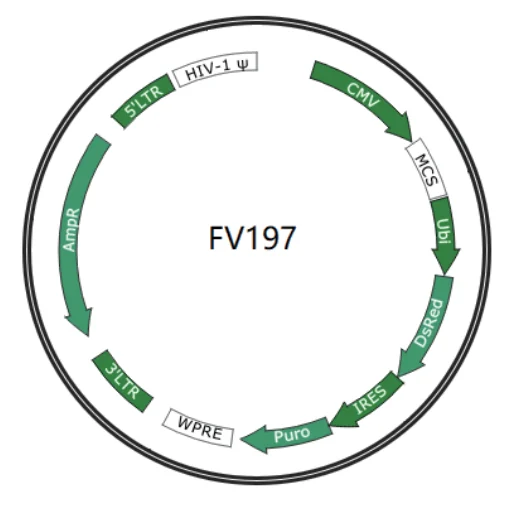
Click the map to enlarge it. Selected elements are annotated on the vector: promoter, expression cassette, selection marker and reporter.
How it works
Lentiviral vectors are enveloped, single-stranded RNA delivery vehicles derived from HIV-1. After the particle enters a target cell, the RNA genome is reverse-transcribed into DNA and the pre-integration complex is actively transported into the nucleus. Because nuclear import does not depend on breakdown of the nuclear envelope, lentivirus transduces non-dividing cells — neurons, myotubes, hepatocytes, primary cells — that retrovirus and plasmid transfection reach poorly.
The transferred genome integrates into the host chromatin as a provirus, so the expression cassette is copied to every daughter cell. That makes lentivirus the standard choice when a stable cell line, a long-term overexpression experiment or a pooled genetic screen is the goal. Expression typically becomes detectable within 24 to 48 hours and persists for the life of the culture.
Our constructs are self-inactivating (SIN): the 3' LTR is deleted in U3, which abolishes LTR-driven transcription after integration and leaves the internal promoter as the only active expression signal. Combined with the split packaging system — gag/pol, rev and the VSV-G envelope on separate plasmids — no replication-competent lentivirus is generated during production. Handle all work under BSL-2 conditions and follow your institution's biosafety review.

Production & quality control
- Vectors are produced by transient co-transfection of HEK293T cells with the transfer, packaging and envelope plasmids; supernatant is harvested 48 to 72 hours after transfection.
- Crude supernatant is clarified, concentrated and buffer-exchanged before release; no serum-derived stabilizer is added unless the product sheet states otherwise.
- Functional titer is reported in TU/mL (transducing units per milliliter), measured on a permissive cell line; sterility, mycoplasma and endotoxin are tested on every lot.
- Replication-competent lentivirus (RCL) testing can be arranged for lots destined for in vivo work — request it when you ask for a quote.
Storage & handling
- Ship on dry ice; store at -80 degrees Celsius for six months or longer.
- For repeated use, thaw once and aliquot into single-use volumes; store aliquots at -80 degrees Celsius.
- Short-term storage at 4 degrees Celsius is acceptable for a few days only, with measurable titer loss each day.
Experimental protocol
-
Plan the transduction
Choose a starting MOI of 1 to 10 for easy-to-transduce lines (HEK293T, HeLa) and 10 to 50 for primary or suspension cells; run a small MOI series the first time. Plate cells so they are 50 to 70 percent confluent on the day of transduction, and include an untransduced control plus, if you will select, a kill-curve plate.
-
Thaw and handle the virus
Thaw a vial quickly in a 37 degree water bath or on ice for larger volumes, mix gently — never vortex — and keep aliquots on ice while working. Avoid more than one freeze-thaw cycle: each one costs roughly an order of magnitude in functional titer.
-
Transduce
Replace the culture medium with fresh complete medium containing the diluted virus. Add polybrene at 4 to 8 micrograms per milliliter only for cell types you have confirmed tolerate it; spinoculation at 800 g for 60 minutes can substitute where polybrene is toxic. Incubate 6 to 16 hours, then replace with fresh medium if the vector or cell type is sensitive.
-
Select or enrich
Start antibiotic selection 48 to 72 hours after transduction at the concentration established by your kill curve (puromycin is commonly 1 to 2 micrograms per milliliter for common lines, but test yours). For fluorescent reporters, enrich by FACS or keep the whole population and record the positive fraction.
-
Confirm and expand
Verify expression by the reporter, flow cytometry, Western blot or qPCR before relying on the line. Expand under selection at the minimum effective pressure, and bank an early passage.
Bench guidance only: optimize multiplicity of infection, selection pressure and timing for your own cell type, and carry out all lentiviral work under the biosafety conditions approved by your institution.
Need the complete PDF manual with lot-specific parameters? Request the manual for FLV197.
Frequently asked questions
Why is my expression silent even though the cells survived?
The most common cause is promoter silencing in the chosen cell type: CMV-driven cassettes often switch off in primary and hematopoietic cells, while EF1a, PGK or CAG promoters hold up better. Moving the cassette to a different promoter construct usually restores expression.
How large an insert can the vector carry?
Packaging efficiency falls sharply once the genome between the LTRs exceeds roughly 8 to 9 kilobases; the practical working budget is closer to 6 to 7 kilobases after the promoter, ORF and polyA are counted. Larger inserts package poorly and yield low titer.
Can I use the virus on non-dividing cells?
Yes. Nuclear import of the pre-integration complex does not require mitosis, which is the main reason lentivirus outperforms standard retrovirus on neurons, macrophages and other quiescent targets.