
Oncolytic adenovirus
OVAD-hTERT-E1A-IRES-E1B-EGFP-RGD
Replication-selective Ad5 constructs that lyse tumor cells and train an antitumor immune response. Catalog number OVAD184-2282,
part of the Oncolytic Adenovirus range. Send the catalog number with your
quantity and we will confirm availability, lead time and price.
Vector map
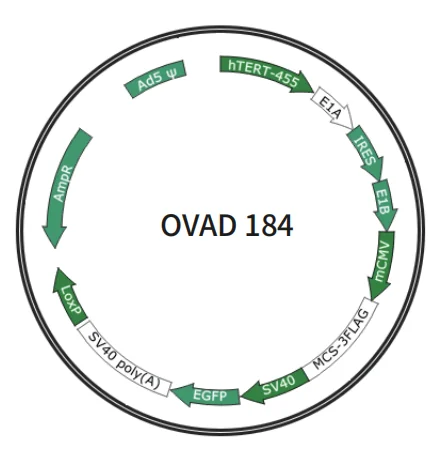
Click the map to enlarge it. Selected elements are annotated on the vector: promoter, expression cassette, selection marker and reporter.
How it works
Oncolytic adenoviruses are replication-competent Ad5 derivatives engineered so that productive replication can only occur in tumor cells. Two selectivity strategies dominate: deleting E1B-55K, which unlinks viral late gene expression from p53 inactivation so the virus replicates only where the p53 pathway is already disabled, and placing E1A under a tumor-selective promoter such as hTERT or survivin so the replication cascade only switches on in cells where that promoter is active.
In a permissive tumor cell the virus runs a full lytic cycle: dozens to thousands of progeny are released as the cell lyses, and each round of infection amplifies within the tumor mass. In a healthy cell with an intact antiviral and cell-cycle checkpoint machinery, replication is abortive and the cell survives.
Lysis is only half of the mechanism. Lytic death releases tumor-associated antigens together with damage-associated molecular patterns and viral PAMPs — an immunogenic-cell-death signal that matures dendritic cells and primes tumor-specific CD8-positive T cells. That second, immune-mediated arm is why oncolytic viruses can produce responses in lesions that were never directly injected, and why they combine naturally with immune checkpoint blockade.

Production & quality control
- Oncolytic Ad5 constructs are amplified in complementing producer cells, purified by gradient ultracentrifugation or chromatography, and formulated in a physiological buffer.
- Infectious titer is reported in PFU/mL; particle count (VP/mL) and particle-to-PFU ratio are reported for consistency between lots.
- Every lot is screened for replication-competent adenovirus contamination and tested for sterility, mycoplasma and endotoxin.
- Selectivity is validated on a tumor versus normal cell panel; ask for the selectivity data sheet when you request a quote.
Storage & handling
- Ship on dry ice; store at -80 degrees Celsius.
- Aliquot after first thaw and avoid repeated freeze-thaw, which shifts the particle-to-PFU ratio upward.
- Do not dilute into media containing serum at room temperature for extended periods before use; work cold and return unused material to -80 degrees.
Experimental protocol
-
Confirm permissiveness in vitro
Run a killing-curve experiment across your tumor models and, ideally, a matched non-malignant line: infect at a range of MOIs and follow viability over 3 to 7 days. Selectivity and potency vary more between tumor models than between viruses.
-
Infect and monitor
Seed tumor cells to 60 to 80 percent confluence, infect in a small inoculum volume for 1 to 2 hours, then restore complete medium. Collect supernatant and cells at 24, 48 and 72 hours to track the lytic cascade by viability assay, plaque assay or viral protein staining.
-
Measure the immune signal
To read out the immunogenic cell death arm, harvest supernatant for HMGB1 and ATP release, and surface-stain cells for calreticulin exposure. In co-culture systems, pair the lysed tumor cells with monocyte-derived dendritic cells and measure T cell activation markers.
-
Combine deliberately
Checkpoint blockade, low-dose chemotherapy that sensitizes to lysis, and cytokine-armed constructs are the standard combination axes. Design the combination so the chemotherapy does not suppress the immune response the virus is priming.
Bench guidance only: replication-competent oncolytic constructs require the biosafety conditions your institution assigns to them — confirm before starting work.
Need the complete PDF manual with lot-specific parameters? Request the manual for OVAD184-2282.
Frequently asked questions
How is selectivity actually enforced in these constructs?
Either by deleting E1B-55K so replication depends on a disabled p53 pathway, or by driving E1A from a tumor-restricted promoter. The mechanism of each construct is stated on its product page and data sheet.
Can it work on tumors that were not directly injected?
Yes — that is the immune-mediated arm. Lytic release of antigens primes a T cell response that can act systemically, which is the rationale for combining oncolytic viruses with checkpoint inhibitors.
What is the difference between PFU and VP here?
PFU counts infectious particles; VP counts total particles including non-infectious ones. The particle-to-PFU ratio is the QC number that keeps potency comparable between lots.